
The Argument From Immaterial Minds
If the mind is immaterial, that’s evidence for theism.

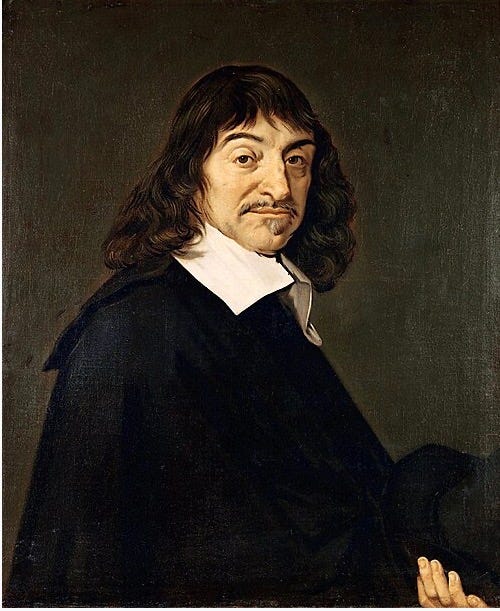
Introduction
The mind–body problem sits near the center of any comprehensive worldview. If the mind is wholly physical — if conscious experience, intentionality, rational insight, and agency are nothing over and above the operations of matter — then atheism can, at least in principle, offer a unified account of what we are. If, by contrast, some aspect of mentality is not wholly physical — if consciousness, rationality, or subjecthood is irreducible to physical facts — then a worldview in which ultimate reality is fundamentally non-mental stands under pressure.
This essay defends a conditional and comparative claim: if any aspect of mentality is immaterial or irreducible to the physical, that fact constitutes evidence for theism over atheism.
The thesis is not that the arguments below conclusively establish immaterialism, nor is it that atheism entails reductive physicalism. The claim is narrower: theism entails that at least one immaterial mind exists — God; atheism does not entail that any immaterial mind exists. If immaterial mentality turns out to be real, that is more antecedently expected on theism than on atheism.
Most contemporary atheism is naturalistic: it holds that ultimate reality is impersonal and non-mental, and that all mental phenomena arise from or supervene upon non-mental physical processes. If mentality is not fully explicable in such terms, then atheists must either detach from naturalism or else accept irreducible mentality as an ontological add-on to their worldview.
My strategy is straightforward. I will survey several serious and largely independent lines of argument that point towards the conclusion that mentality is not wholly physical. Then, I will argue that if even some of those arguments have force, that constitutes non-trivial evidence for theism over atheism.
1. The Modal Argument
The modern discussion of immaterial mind begins with René Descartes. In the Meditations, he argues that because he can clearly and distinctly conceive of himself as a thinking thing without extension, and of body as extended without thought, mind and body must be really distinct substances (Descartes 1641).
Few contemporary philosophers accept Descartes’s epistemology wholesale. But the modal intuition underlying his argument remains powerful: the mental seems conceptually separable from the physical, and that separability appears to have metaphysical significance.
David Chalmers’s zombie argument recasts Descartes’s intuition (Chalmers 1996). We can coherently conceive of a world physically identical to ours — identical in every microphysical respect — yet lacking phenomenal properties (i.e., lacking consciousness). If such a world is metaphysically possible, then phenomenal facts are not entailed by physical facts.
The force of the argument is not that conceivability guarantees possibility. Rather, it lies in the fact that the explanatory gap — the gap between a physical description of a mental state and its subjective quality — remains even when we specify the complete physical story. It remains intelligible to ask why these physical facts should give rise to experience at all. That intelligibility suggests a lack of metaphysical entailment.
The Modal Argument
1. If the mind is wholly physical, then the total physical facts metaphysically entail all mental facts.
2. A world physically identical to ours but lacking consciousness is coherently conceivable.
3. Coherent conceivability is prima facie evidence of metaphysical possibility.
4. Therefore, it is prima facie evidence that the total physical facts do not entail the mental facts.
5. If the physical facts do not entail the mental facts, then mentality is not wholly physical.
6. Therefore, mentality is probably not wholly physical.
If that conclusion is correct, then irreducible mentality is a serious metaphysical possibility — and that matters for our later comparative question.
2. The Epistemic Argument
Thomas Nagel argued that objective physical description seems structurally incapable of capturing subjective character (Nagel 1974). One can know everything about a bat’s neurophysiology and behavior and still not know what it is like to be a bat. This gap is structural, not merely empirical: a physical description of a bat is the wrong kind of description for capturing the bat’s phenomenology (so, the problem isn’t just that science hasn’t progressed far enough).
Frank Jackson sharpened this intuition with his famous case of Mary the neuroscientist (Jackson 1982; 1986). By stipulation, Mary knows all the physical facts about color vision while confined to a black-and-white environment. When she sees red for the first time, she learns what it is like to see red. If she gains new knowledge not contained in the complete physical description, then physical knowledge is not complete knowledge of mentality.
The Epistemic Argument
1. If mentality is wholly physical, then complete knowledge of all physical facts would amount to complete knowledge of all facts about mentality.
2. It is possible to possess complete knowledge of all physical facts while lacking knowledge of what it is like to have certain experiences.
3. When one acquires such phenomenal knowledge, one gains knowledge not contained in the complete physical description.
4. Therefore, complete physical knowledge is not complete knowledge of all facts about mentality.
5. Therefore, mentality is probably not wholly physical.
3. The Argument From Introspective Awareness
Michael Huemer’s phenomenal conservatism holds that if it seems to one that p, one thereby has prima facie justification for believing p, absent defeaters (Huemer 2006). Introspective seemings therefore count as evidence.
When I introspect conscious experience, it does not present itself as spatially extended, divisible, or measurable in the way physical objects are. It presents itself in a qualitative manner, from a first-person standpoint. If reality is fundamentally non-mental and physical (as standard naturalistic atheism holds), then introspection would be systematically misleading about the nature of experience.
The Argument from Introspective Awareness
1. Introspection provides prima facie justification concerning the nature of conscious experience.
2. Introspection presents conscious experience as qualitative and non-spatial in a way not plausibly attributable to physical properties as such.
3. If conscious experience has features not plausibly attributable to physical properties, then it is not wholly physical.
4. Therefore, mentality is probably not wholly physical.
4. The Argument from Rational Normativity
We recognize logical inconsistency. We evaluate arguments as valid or invalid. We notice that inflicting pain merely for fun is categorically wrong. These capacities relate both to the normative (they concern what one ought to believe or do) and to the necessary (they concern what could not fail to be the case).
The striking feature of such cognition is that it purports to track objective standards that do not depend on our biology, culture, or evolutionary history. The law of non-contradiction is not contingently useful; it is necessarily true. The wrongness of gratuitous cruelty is not merely maladaptive; it is, if real, objectively binding. When we reason, we take ourselves to be responsive to standards that transcend causal description.
Nagel argues in Mind and Cosmos that reductive naturalism struggles to account for rationality itself (Nagel 2012). Evolution by natural selection selects for traits conducive to survival and reproduction. It does not select for apprehension of necessary truths as such. Of course, having generally reliable cognitive faculties may be instrumentally useful. But instrumental reliability is not the same as genuine responsiveness to objective, necessary standards. A belief-forming mechanism could be evolutionarily successful without being truth-directed in any robust sense.
The point can be put more sharply. On atheism, ultimate reality is not fundamentally rational. It consists of non-mental processes governed by impersonal laws. If rational insight into necessary truths exists, it arises from — or supervenes upon — such non-rational foundations. That does not make rationality impossible. But it renders it, at minimum, metaphysically unexpected. By contrast, on theism, ultimate reality is itself a rational mind. If finite minds exist within such a reality, it is antecedently unsurprising that they would be capable of tracking logical and moral necessity.
Adam Pautz presses a related but more specific epistemic point. He argues that phenomenal acquaintance places us in a distinctive cognitive relation to properties — a relation not reducible to physical-functional description (Pautz 2017). If conscious experience affords direct awareness of certain features of reality, then our epistemic access to truths may depend essentially on the irreducibility of consciousness itself. In that case, rational normativity and phenomenal consciousness are intertwined: the authority of reason may depend on a kind of cognitive contact that cannot be captured in purely third-person terms.
Whether one accepts Nagel’s or Pautz’s arguments in full, the broader pressure remains. Rationality is not merely a pattern of neural firings. It is responsiveness to normative standards that purport to hold necessarily and universally. If those standards are real, and if we genuinely apprehend them, then mentality includes capacities that are not plausibly explicable in wholly non-normative physical terms.
The Argument from Rational Normativity
1. If mentality is wholly physical, then its cognitive capacities are wholly explicable in non-normative physical terms.
2. Mentality includes capacities essentially involving responsiveness to normative and necessary truths.
3. Such capacities are not plausibly explicable in purely non-normative physical terms.
4. Therefore, mentality is probably not wholly physical.
If that conclusion is even moderately plausible, then rationality itself is an irreducible feature of reality.
5. The Argument from Universals
When we grasp triangularity, number, or logical validity, we grasp universals — not merely particular instances. The objects of intellectual apprehension are abstract and not spatially located.
In the Aristotelian–Thomistic tradition, developed in contemporary form by Edward Feser, matter individuates; intellectual cognition abstracts from individuating material conditions (Feser 2013; 2014). If the intellect were wholly material, its operations would be constrained by material particularity. Yet the intellect apprehends what is universal and repeatable across instances.
The materialist may respond that universals are simply represented in the brain via token neural states. But representation is precisely the issue: how can a particular, spatially located configuration have as its proper object something non-particular?
The Argument from Universals
1. The human intellect grasps universals.
2. Universals, as such, are not particular material entities.
3. A power whose proper objects are universals is not wholly material.
4. Therefore, mentality is probably not wholly physical.
6. The Unity Argument
Conscious experience is presented as unified. At a time, there is one field of awareness for one subject. Visual, auditory, tactile, affective, and cognitive elements are given together as aspects of a single perspective. The unity here is not merely functional coordination; it is unity of subjecthood. There is someone for whom these experiences are present.
Nagel’s discussion of split-brain cases is instructive (Nagel 1971). Commissurotomy cases press us to ask what exactly the unity of consciousness consists in, and whether it can be straightforwardly identified with the unity of a physical system. The empirical details are complex. But the philosophical pressure is clear: does dividing the brain divide the subject? If so, how? If not, why not?
Physical systems are composites of separable parts. Their unity is a unity of organization and causal integration among those parts. A brain is one system in virtue of its functional and causal structure. But the unity of consciousness appears to be a unity of subjecthood — a single point of view that is not obviously analyzable into spatially distinct components.
Swinburne presses this contrast sharply. He argues that if a subject of experience were identical to a physical object, then it would be composed of parts in the way physical objects are. But the subject of experience does not appear to be composed of experiential parts corresponding to neural parts. Rather, the subject seems to be a numerically single bearer of experiences — something that has experiences, rather than something that is a mere aggregate of experiential events (Swinburne 1986/1997; 2013).
The issue is not whether a composite can count as “one thing” in an ordinary sense. Organisms, storms, and institutions are all unified entities. The question is whether the unity of a composite suffices to ground the unity of a single subject of experience — a numerically single first-person perspective — as opposed to merely coordinated subpersonal processes.
The Unity Argument
1. Conscious experience is presented as unified: at a time, there is a single subject with a single field of awareness.
2. Purely physical systems are composites of separable parts whose unity consists in causal and functional organization.
3. The unity of a numerically single subject of experience is not plausibly identical to the unity of a composite physical system.
4. Therefore, mentality is probably not wholly physical.
7. The Argument from Personal Identity
We take ourselves to persist as subjects over time. That persistence underwrites responsibility for past actions and prudential concern for future experiences. When I regret a past action, I take myself to be identical with the agent who performed it. When I anticipate future pleasure or pain, I anticipate that I will undergo it. The thought is not merely that someone psychologically continuous with me will exist. It is that I will exist.
Material organisms, however, are constantly changing aggregates. Cells are replaced. Neural states shift. Psychological dispositions evolve. A purely physical object persists by virtue of causal and structural continuity among its parts. Its identity over time consists in the right sort of continuity of organization.
Many philosophers, most influentially Derek Parfit, have argued that personal identity is reducible to psychological continuity and connectedness. In Reasons and Persons, Parfit maintains that there is no further fact of the matter beyond overlapping chains of memory, intention, character, and other psychological relations (Parfit 1984). On this reductionist view, strict identity may not even be what fundamentally matters. What matters in survival is psychological continuity, even if identity is not preserved in the strict numerical sense.
But reductionist accounts face a difficulty. Psychological continuity admits of degrees and can, at least in principle, branch. In fission cases — where one brain is divided and each half preserves enough psychological structure — two future individuals might stand in equal continuity relations to an earlier person. Yet they cannot both be numerically identical to that person. Parfit’s response is deflationary: perhaps identity is not what matters. Yet from the first-person standpoint, this response appears revisionary. When I anticipate tomorrow’s experience, I do not merely anticipate that someone psychologically continuous with me will exist. I anticipate that I — the very same subject — will exist.
Swinburne presses this contrast explicitly. He argues that personal identity cannot be analyzed in terms of bodily or psychological continuity because such continuities are compatible with duplication in ways strict identity is not (Swinburne 1986/1997; 2013). If identity were nothing more than continuity relations, then there would be no further fact of the matter in branching cases. But our concept of a persisting subject appears to involve numerical identity — the continued existence of one and the same subject of experience.
The deeper metaphysical question, then, is what grounds the persistence of a subject. A physical system persists as long as its parts are appropriately causally related. But a subject of experience does not appear to be merely a causally integrated collection of parts. It appears to be the bearer of experiences — something that has experiences, rather than something that is identical to a structured aggregate of them.
The claim is not that this establishes Cartesian substance dualism. The claim is narrower: the persistence of a numerically identical subject of experience does not sit comfortably within a picture on which all that exists are changing physical aggregates whose identity conditions consist solely in continuity relations among parts. If there is a persisting subject that remains numerically the same through change, that subject is not plausibly identical to any aggregate whose identity conditions are wholly physical.
The Argument from Personal Identity
1. We have strong prima facie evidence that there is a numerically identical subject of experience persisting over time.
2. Purely physical objects are aggregates whose persistence consists in causal and structural continuity among changing parts.
3. The persistence of a numerically identical subject of experience is not plausibly identical to the persistence of a changing physical aggregate or continuity relation among such aggregates.
4. Therefore, mentality is probably not wholly physical.
8. The Argument from Intentionality
Franz Brentano famously held that intentionality — aboutness — is the “mark of the mental” (Brentano 1874/1973). Beliefs are about states of affairs; thoughts represent objects; judgments have truth-conditions. To think that Paris is beautiful is to stand in a relation to Paris. Mental states are not merely occurrences; they are directed toward something.
This feature of mentality is pervasive. Desires are about possible states of affairs. Perceptions purport to present the world as being a certain way. Even hallucinations and false beliefs are about something — they have intentional content — despite misrepresenting reality.
The difficulty arises when we attempt to locate intrinsic intentionality within a purely physical ontology. Physical states, as described by physics, are characterized in terms of mass, charge, spin, spatial location, and causal relations. Nowhere in that vocabulary do we find reference, meaning, truth-conditions, or aboutness. A neuron firing is not, in itself, about Paris. It is an electrochemical event. One may interpret it as representing Paris, but interpretation is not obviously the same thing as intrinsic intentionality.
Contemporary philosophy of mind has devoted enormous effort to naturalizing intentionality — that is, to explaining how representational content could arise within a wholly natural world. Causal and informational accounts attempt to ground content in lawlike covariance relations between internal states and external conditions. On such views, a mental state represents what it reliably carries information about (Dretske 1981; Fodor 1987). Teleosemantic accounts refine this strategy by appealing to evolutionary function: a state represents what it was selected to track in the course of natural selection (Millikan 1984; Papineau 1987). Functional role or conceptual role theories, by contrast, attempt to explain content in terms of the inferential and causal role a state plays within a broader cognitive system (Block 1986; Harman 1982). Each of these approaches aims to show how intentionality could be constituted by non-semantic relations — causal, informational, biological, or functional — describable in naturalistic terms.
These proposals are sophisticated, but each faces a persistent difficulty: the problem of misrepresentation. If a belief represents Paris but Paris does not exist, or if it falsely attributes a property to Paris, what grounds the distinction between correct representation and error? Causal correlation alone does not suffice, since misrepresentation can occur even in the absence of the relevant external object. Teleological function helps, but evolutionary history does not straightforwardly generate determinate truth-conditions. And functional role accounts often appear circular, invoking semantic notions to explain semantic content.
Feser presses this point from an Aristotelian–Thomistic perspective. He argues that attempts to reduce intentionality to physical or functional relations tend to presuppose the very semantic notions they aim to explain (Feser 2013; 2014). If so, then the reduction fails: intrinsic aboutness is not derived from non-semantic ingredients but taken for granted in the explanatory framework.
The core difficulty can be stated simply. Aboutness is normative. A belief can be true or false; a representation can succeed or fail. That normative dimension is not captured by the descriptive vocabulary of physics. If intentionality is intrinsic to mentality — if our thoughts genuinely represent rather than merely being interpreted as representing — then there is something in the mental that is not plausibly identical to mass, charge, and motion.
The claim here is not that naturalistic accounts are incoherent. It is that they remain deeply controversial and arguably incomplete. And if intrinsic intentionality cannot be reduced to purely physical facts, then mentality includes an irreducible feature.
The Argument from Intentionality
1. Mental states possess intrinsic intentionality: they are about or represent objects and propositions and have truth-conditions.
2. Purely physical states, as described by physics, do not possess intrinsic intentionality; any aboutness attributed to them is derivative or interpretive.
3. Intrinsic intentionality is not plausibly reducible to purely physical relations without presupposing semantic notions.
4. Therefore, mentality is probably not wholly physical.
9. The Argument from Agency
In deliberation, we take ourselves to weigh reasons and settle on actions because those reasons count in favor of them. When I choose, I do not merely register the outcome of competing neural processes. I take myself to be the one who decides. Moral responsibility presupposes that agents are genuine sources of action — that they are not merely locations where events happen, but originators of action in light of reasons.
The central question is not whether determinism is true. The deeper question is whether agency can be fully captured in terms of impersonal physical causation. If the mind is wholly physical and the physical domain is causally closed, then every action is entirely fixed by prior physical states, whether deterministically or indeterministically. In either case, what ultimately explains the action is a chain of physical events governed by impersonal laws.
But rational agency is not merely a sequence of events. It is the settling of a question in light of reasons. When an agent acts for a reason, the reason is not merely a cause among others; it is taken to justify the action. The agent is responsive to normative considerations. That responsiveness is central to what makes the action hers.
Libertarian accounts of agency — including those of Chisholm, Kane, and O’Connor — attempt to articulate this idea in terms of agent causation or self-forming action (Chisholm 1964; Kane 1996; O’Connor 2000). Their shared intuition is that an action must originate in the agent in a way not reducible to prior impersonal causes. One need not accept every detail of these accounts to see the pressure they identify: if agency is nothing more than the outcome of impersonal physical processes, then it is unclear in what sense the agent is the true source of action.
More fundamentally, agency appears to involve irreducible normativity. To act intentionally is to act under a description, to take certain considerations as reasons, and to settle on an action because it is supported by those reasons. The explanation of action is therefore partly normative, not merely causal. A purely physical description — one that specifies only prior states and laws — abstracts away from the standpoint of the agent as reason-responsive subject.
The issue, then, is not simply whether determinism is compatible with freedom. It is whether agency itself — understood as reason-responsive sourcehood — can be identified with or reduced to the workings of a causally closed physical system. If agency is real in that robust sense, then it is not plausibly identical to a sequence of impersonal physical events.
The Argument from Agency
1. We have strong prima facie evidence that we are genuine agents who deliberate and act for reasons.
2. Genuine agency involves reason-responsive sourcehood — the settling of action in light of normative considerations.
3. Purely physical processes, governed by impersonal causal laws, do not plausibly constitute reason-responsive sourcehood.
4. Therefore, genuine agency is probably not wholly physical.
5. Therefore, mentality is probably not wholly physical.
10. A Note Before Proceeding
It may not be that all of the above arguments succeed. I’m personally not sure they do. Each is controversial, and each faces sophisticated resistance. But they are also importantly independent. The modal argument does not stand or fall with the epistemic argument; the argument from intentionality does not presuppose the argument from agency; the appeal to universals differs in structure from the appeal to phenomenal knowledge.
If even some of these lines of reasoning have force, then the hypothesis that mentality is not wholly physical is not an eccentric outlier but a live metaphysical option. And if irreducible mentality is even moderately plausible, that fact is sufficient to generate comparative pressure between theism and atheism.
11. Atheist Resistance
An atheist may concede irreducible mentality and adopt panpsychism, emergentism, or neutral monism. None of these views is incoherent.
The question is comparative. Theism entails at least one immaterial mind — a necessary, uncaused mind at the foundation of reality. On atheism, any irreducible mentality must either emerge from non-mental foundations or exist as an unexplained feature of reality.
On classical theism, God is necessary. His necessity is metaphysical, not brute contingency. On atheism, irreducible mentality — if fundamental — would be an unexplained addition to a worldview originally motivated by non-mental ontology.
This does not refute atheism, but it alters the explanatory landscape.
12. The Evidential Comparison
The evidential principle at work in this essay is modest but important. When two hypotheses are live options, and a given datum is more to be expected on one hypothesis than on the other, that datum constitutes evidence in favor of the former relative to the latter. The claim need not be that the datum entails the preferred hypothesis, nor that the rival hypothesis cannot accommodate it. The claim instead is comparative: it concerns fit and explanatory expectation.
Theism holds that ultimate reality is grounded in an immaterial, rational mind. On classical theism, God is a necessary being whose nature includes intellect and will. If that is so, then mentality is not an accidental latecomer in the structure of reality. It is fundamental. Finite minds, if they exist, would not be metaphysical anomalies but, rather, derivative instances of a more basic mental reality.
Atheism, by contrast, denies the existence of any such foundational mind. Ultimate reality, on atheism as such, is not inherently mental. Of course, atheism is compatible with many further metaphysical commitments. One might hold that irreducible mentality is a fundamental feature of reality, or that consciousness is a brute emergent fact, or that panpsychism is true. But none of these commitments follows from atheism itself. If immaterial or irreducible mentality exists on atheism, it does so as an additional posit — not as something anticipated by the core thesis.
The contrast can be put more sharply. On theism, the existence of irreducible mentality is structurally unsurprising. A mind-first ontology naturally makes room for minds. On atheism, irreducible mentality must either be reduced to non-mental foundations or treated as a brute addition to an otherwise non-mental reality. If reduction fails — as the preceding sections have argued is plausible — then irreducible mentality becomes an unexplained feature of a mindless foundation.
One might object that theism itself posits a brute fact: God. But classical theism does not treat God as a contingent brute. God is posited as a necessary being — one whose non-existence is metaphysically impossible and whose nature explains his existence. By contrast, finite immaterial minds arising within an atheistic framework would not be necessary in that sense. They would be contingent features of reality without grounding in a deeper mental foundation.
None of this shows that atheism is false. Nor does it show that theism is uniquely confirmed. The claim is narrower: if irreducible mentality exists — if the mind is not wholly explicable in non-mental terms — then that fact fits more naturally within a worldview that already posits mentality at the foundation of reality than within one that does not.
Therefore, if the arguments of the preceding sections provide even modest support for the existence of immaterial or irreducible mentality, they provide corresponding evidential support for theism over atheism.
Conclusion
None of the arguments surveyed here is decisive in isolation. Each has been contested in the literature. But taken together, they generate sustained pressure against the claim that mentality is wholly physical. Conscious unity, numerical personal identity, intrinsic intentionality, rational normativity, abstraction to universals, and genuine agency each point, in different ways, beyond a purely physical ontology.
The thesis defended in this essay has been conditional and comparative. I have not argued directly for theism; instead, I have argued that if any aspect of mind is irreducible to the physical — if consciousness, intentionality, rational insight, or agency cannot be exhaustively explained in non-mental terms — then that fact is better accounted for on theism than on atheism. The question, then, is not whether theism follows deductively from anti-physicalism, but whether irreducible mentality fits more naturally within a worldview that posits mind at the foundation of reality than within one that does not.
Theism posits a necessary, immaterial mind at the foundation of reality. On such a view, mentality is fundamental rather than accidental. Finite minds are not metaphysical anomalies but derivative expressions of a more basic mental reality. Atheism, by contrast, does not include mentality in its foundational commitments. If irreducible mentality exists on atheism, it does so either as a brute addition or as an emergent feature of non-mental foundations — both of which require further explanatory work.
The strength of the evidential support for theism therefore tracks the strength of the case for irreducible mentality. The more compelling the arguments against a wholly physical account of mind, the stronger the comparative support for a mind-first ontology.
The mind–body problem is thus not a peripheral technical puzzle. It lies near the center of our metaphysical picture. If mind is not merely matter arranged thus-and-so, that fact is not neutral with respect to worldview comparison: it favors a worldview on which mind is fundamental. Thus, it favors theism over atheism.
References
Block, Ned. “Advertisement for a Semantics for Psychology.” Midwest Studies in Philosophy 10 (1986).
Brentano, Franz. Psychology from an Empirical Standpoint. 1874. (English trans. 1973).
Chalmers, David. The Conscious Mind. Oxford University Press, 1996.
Chisholm, Roderick. “Human Freedom and the Self.” The Lindley Lecture. University of Kansas, 1964.
Descartes, René. Meditations on First Philosophy. 1641.
Dretske, Fred. Knowledge and the Flow of Information. MIT Press, 1981.
Feser, Edward. Philosophy of Mind. Oneworld, 2013.
Feser, Edward. Scholastic Metaphysics. Editiones Scholasticae, 2014.
Fodor, Jerry. Psychosemantics. MIT Press, 1987.
Harman, Gilbert. “Conceptual Role Semantics.” Notre Dame Journal of Formal Logic 23 (1982).
Huemer, Michael. “Phenomenal Conservatism.” American Philosophical Quarterly 43 (2006).
Jackson, Frank. “Epiphenomenal Qualia.” The Philosophical Quarterly 32 (1982).
Jackson, Frank. “What Mary Didn’t Know.” The Journal of Philosophy 83 (1986).
Kane, Robert. The Significance of Free Will. Oxford University Press, 1996.
Millikan, Ruth. Language, Thought, and Other Biological Categories. MIT Press, 1984.
Nagel, Thomas. “Brain Bisection and the Unity of Consciousness.” Synthese 22 (1971).
Nagel, Thomas. “What Is It Like to Be a Bat?” The Philosophical Review 83 (1974).
Nagel, Thomas. Mind and Cosmos. Oxford University Press, 2012.
O’Connor, Timothy. Persons and Causes: The Metaphysics of Free Will. Oxford University Press, 2000.
Papineau, David. “Representation and Explanation.” Philosophy of Science 54 (1987).
Parfit, Derek. Reasons and Persons. Oxford University Press, 1984.
Pautz, Adam. “The Significance Argument for the Irreducibility of Consciousness.” Philosophical Perspectives 31 (2017).
Swinburne, Richard. The Evolution of the Soul. Oxford University Press, 1986; rev. ed. 1997.
Swinburne, Richard. Mind, Brain, and Free Will. Oxford University Press, 2013.